The Prague Quadrennial memories and future
Helena Hantáková; Anna Hejmová
Founded in 1959, the Theatre Institute in Prague provides the Czech and international public with a comprehensive range of services in the field of theatre and individual services connected to other branches of the arts (music, literature, dance, and visual arts). The Institute has at its disposal one of the largest theatre libraries in central Europe, a video library, photo archives, a rich documentation, and a bibliographical collection. From the beginning in 1967 until today, the Prague Theatre Institute, recently transformed into the Czech Cultural Institute, has been the main organizer of the international exhibition and festival of scenography, Prague Quadrennial (PQ).
The foundation of PQ was inspired by the great success of Czech scenography at the São Paulo Art Biennial in 1959. The agreement between the Fundacao Bienal de Sao Paulo and PQ was signed in 1969, and the main deal was to share the stage design exhibitions organization every two years. From the very beginning, PQ was one of the rare open windows to the international theatre world, mainly for people from communist countries. Each edition brought the newest stage design information and was an opportunity for sharing the knowledge and crossing the Iron curtain. The role of the meeting point did not disappear after the European political changes in 90th years of the 20th century. The number of exhibitors and visitors increases every four years.
For nearly 60 years, the PQ has been the world’s largest exhibition and festival dedicated to scenography, performance design, and performance space. Since its founding in 1967, PQ has continuously evolved, navigating political and cultural shifts while remaining a vital space for scenography experimentation and innovation.
Taking place regularly without interruption, it has grown into a global meeting ground for performance designers, artists, scholars, and students, fostering interdisciplinary and intergenerational exchange across different artistic and cultural backgrounds.
As a festival event PQ consists of several program sections, both competitive and non-competitive. The main award of the Quadrennial is the Golden Triga.
The form of the prize was inspired by the statute which has decorated the roof of the National Theater in Prague since 1911.
Some of the program sections, such as the traditional Exhibition of Countries and Regions and the Student Exhibition, are curated by representatives of the participating countries and regions, while other program sections are prepared by the international PQ curatorial team. Each edition of PQ is unique, and its form grows out of the vision of the artistic leadership.
Prague Theatre Institute, transformed to the Art Institute and recently to the National cultural institute, was not only the main PQ organizer but also the keeper of all kinds of materials which were born during the exhibitions and about them from 1967 until today. We can sort this heritage into several categories:
1) Official documents
2) Photographs/videos/audio
3) Magazine articles
4) Exhibition leaflets, invitations, small prints
5) Part of collections
6) Exhibition catalogues
7) Books about PQ
All these materials are stored in classical way – in boxes, storage and on library shelves and the digital one on servers and clouds. The gate to them is the Virtual study.
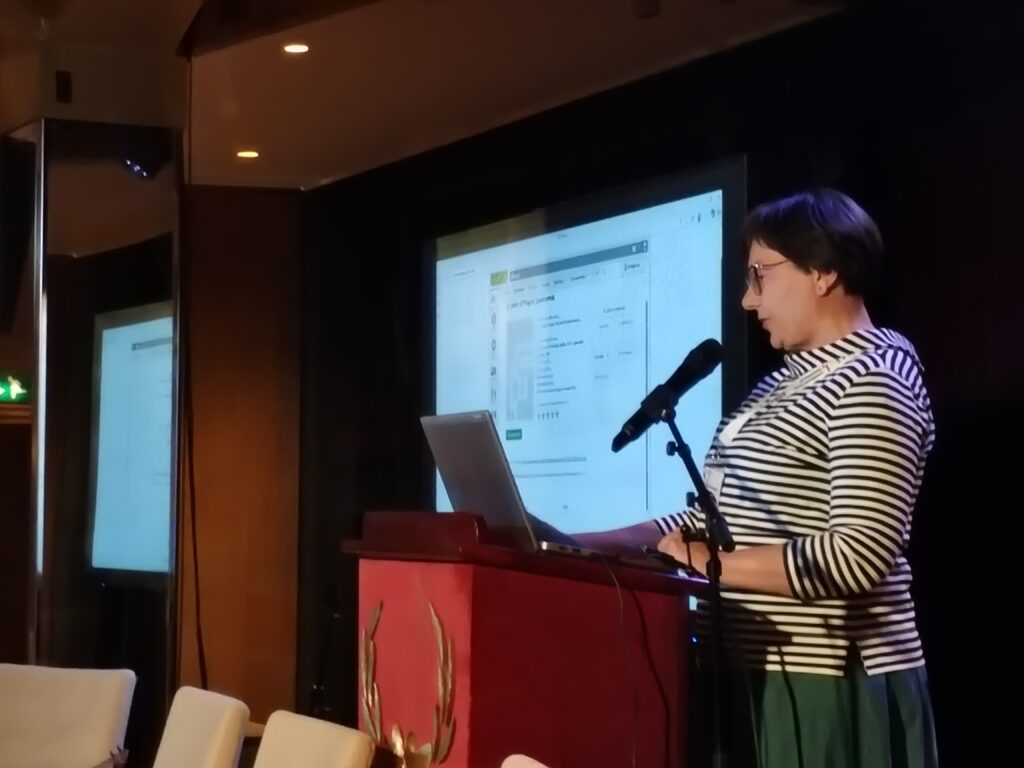
The Virtual Study is a comprehensive interface for accessing the Theatre Institute databases. The related databases provide direct access to digital items. There is the digital form of PQ catalogues and very important book about PQ history in the digital library Kramerius.
The 50th anniversary of PQ in 2017 brought the history of the events in the e-book called 50 years of Prague Quadrennial pq_tisk.pdf
But it is really very little number of digital items compared to the more than 1 200 paper books about PQ in the library.
Full texts of magazine articles are available in the Bibliography database. Currently there are 3 622 digital articles with the PQ theme and the number increases when the new one appears.
Information about the PQ events is also available in the Theatre events database.
The Virtual study guides the people to the PQ items which are in the several departments and their databases. The new era for exhibition archiving came in 2023. The last PQ was a special one in thinking about keeping the exhibition memory.
For the first time they created a comprehensive Digital Archive of the event with open access. The motivation has been to preserve the memory, knowledge and artistic practices presented during the 15th PQ festival. One of the most interesting parts – from my point of view – are PQ Talks. Live talks about all topics of the performance art sort to the categories by the subject.
The PQ Archive 2027
As PQ approaches its 60th anniversary in 2027, PQ team, and especially its artistic director Barbora Přihodová and PQ’s Archive Specialist Anna Hejmová, has started preparing PQ 60, a special program that will focus on the Prague Quadrennial in its transformations over the past six decades. The aim of PQ 60 is not only to recognize PQ’s continuous existence but also to reflect on its role as a platform for scenography worldwide and, ultimately, chart paths for the future.
In line with these efforts, PQ has continued and expanded the care for archival materials related to PQ, including a systematization and digitization of PQ Archives.
Current situation:
Each collection is registered as a collection fund that is not subject to the Archives Law and is administered by the Collections and Archives Department; the physical originals are stored in the Czech Cultural Institute Archives (Celetná 17, Prague). The PQ archive has not yet been systematically and comprehensively organized; it is unsorted, lacks archival finding aids, and is constantly being added to.
Content of the archive:
1) Text archival materials: correspondence, catalogues, publications, attendance sheets, printed materials (newspaper clippings), notes, minutes, contracts; we believe it would be useful to be able to view specific pages in multi-page documents (e.g., catalogues)
2) Visual archival materials: photographs of performances in the context of expanding scenography, photographic reproductions of costume and set designs, colour and black-and-white images, various references
3) Audio records: interviews, digitized audio recordings from the PQ archive
4) Video records: film footage, audiovisual documentation, original videos
The PQ team’s priorityis not the preservation of original artifacts, but their presentation to the global public so that they can be fully used for artistic and academic research; the central priority is to present the history of PQ as a unique global phenomenon.
Concept for the Digitization and Accessibility of PQA Data
We do not approach digitization as “archiving the past,” but rather as “use of data about scenography.” The project makes use of technologies that are standard in the commercial sector or in everyday life, a shift from “documentation of scenography” to “analysis of documentation”. We are ready to prepare the digital humanities framework which brings a shift from „static images„ to “living data” and offers new possibilities for historiographical and artistic research.
There was a long discussion about the accessibilityof the archive items. Researchers know what they are looking for and anticipate what they will find. There is the direct search (year – country and region – name) designed for them. The data visualization in a linear arrangement offers a quick overview of the data content. Art researchers will utilize the unique structure of relationships based on multimodal search. Thanks to associative text and image search, laypeople can discover and learn about the history of the PQ phenomenon in a natural way. Due to the copyright the access to the archive will be restricted to registered users.
Our main goal is the democratization of research in a global and inclusive context. We would like to create a user-friendly, creative web archive suitable for both academic and artistic research, as well as for deaf and partially sighted researchers, which will allow users to search not only basic metadata— name, year, country and region, but also to detect content in textual (PDF), visual (TIFF in DTB, web in JPG), audio, and audiovisual materials through multimodal “full-text” search. The website should also include data visualization (lines and networks/entities).
“Looking back at both past and recent transformations of PQ, it is also important to consider what we may have missed. What have we overlooked? Where are the proverbial blind spots? What has been absent, unseen, or unheard? These questions matter not only because they lead us into the past, but also because they prepare the ground for the future.”
Barbora Příhodová, artistic concept, https://pq.cz/pq2027/artistic-concept/